

vCISO vs CISO: Which One Is Right for Your Business?
With the incorporation of advanced technology in business and the increased threat of cyberattacks lurking, organizations are often pressured to keep their data in check. A recent McKinsey Global Institute study has revealed that companies that provide extra effort to keep their data secured are more likely to get more clients and 19 times as likely to be profitable as a result. This is where the debate of vCISO vs CISO becomes critical for businesses as a better option to enhance cybersecurity, but even with these traditional CISOs, some organizations can face challenges in cybersecurity. These challenges are often addressed by virtual CISO (vCISO). In this blog, we will discuss vCISO vs CISO, their key differences, their responsibilities, and which one to choose.
What is an in-house CISO? vCISO vs CISO Explained
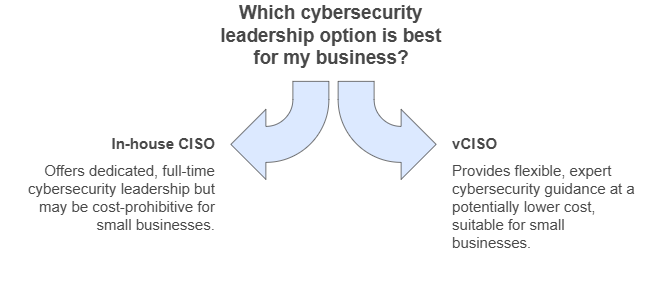
Regarding in-house Chief Information Security Officer (CISO) is an officer responsible for developing and implementing cybersecurity strategies and programs to ensure compliance with government regulations. They provide a strategic approach to implementing security policies and procedures that resonate with your business aspirations. In-house CISO oversees the security testing including performing vulnerability scans, web application security assessments, and penetration tests, and supervises the internal security team to ensure the organization’s hardware and software are equipped to comply with regulatory standards.
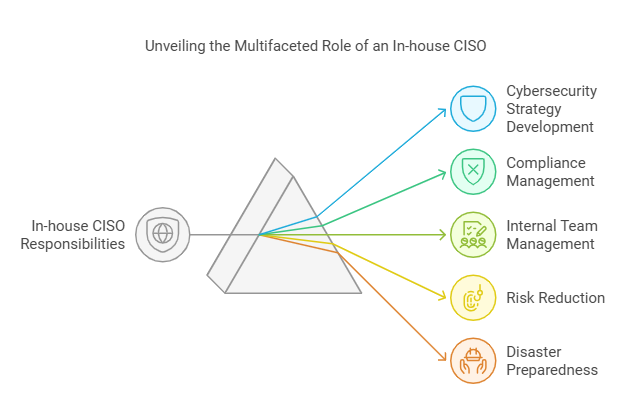
In-house CISOs are especially efficient and play a key role in large organizations. From the organization’s primary security measure to developing disaster recovery plans, CISO is actively involved in all tasks related to information security and ensures the entire team is on board with the security strategies. An In-house CISO is always at the beck and call of the organization during any crisis; even then, finding the most suitable candidate is a very time-consuming task. During these hours of search for an ideal CISO, one might still need to develop cyber security strategies and risk assessment; this is where the idea of a virtual CISO becomes more prominent.
What is vCISO?
The virtual Chief Information Security Officer has the same responsibilities and roles as an in-house CISO, but instead of a full-time company-employed officer, the vCISO does the job virtually or remotely. vCISO oversees the data security of an organization on a contract basis and is more flexible with its involvement by providing strategic guidance and risk assessment. As the name Virtual Chief Information Security Officer (vCISO) itself suggests, they operate virtually, making their role more diverse and can even be acquainted with multiple organizations, providing them with security expertise.
This exposure to a wide range of cybersecurity challenges allows them to develop strategic solutions across different scenarios. As a result, vCISOs often bring a broader level of expertise, which can be invaluable when an organization faces a unique security crisis. vCISO is considered a better alternative. In the context of vCISO vs CISO, small and mid-sized businesses often find a vCISO more practical.

vCISO vs CISO: What Are the Major Differences?
Although a vCISO and an in-house CISO share the same overarching goal, their approaches differ significantly. Let’s analyze some of their key differences.
| Aspect | vCISO | In-house CISO |
| Scope | Hired on a contractual basis to focus on specific areas like compliance or to provide expert recommendations to strengthen the organization’s defense mechanism. | Considered the high-ranking executive of a company, responsible for managing the internal security team, covering broad aspects of cybersecurity, and ensuring industry compliance. |
| Flexibility | More flexible and evolving to the changing security landscape by providing customized security strategy. | Less flexible because they are bound to more responsibilities and full-time employment, making it difficult to change strategies at go. |
| Running cost | Because vCISOs work on a contract basis, organizations can engage them on an as-needed basis, focusing only on specific security areas. | The average CISO salary in the USA vary based on their expertise. |
| Involvement in daily operation and long-term planning | Less likely to be part of daily security operations but provides valuable cybersecurity guidance to meet business compliances. | They are involved in daily security operations to strengthen the overall posture of cybersecurity and are more likely to be part of long-term planning with close association with executives and the IT team. |
| Employee experience and expertise | Providing high-level security with more insight into cyber-security crises and backed by the expertise of certified professionals in the field | Depending on the officer or officers hired their expertise can be limited and less flexible. |
| On-boarding process | Easy onboarding process as there is no recruiting delay | With multiple candidates selection process, the onboarding can be delayed |
| Integration into the system | Since they are a third-party party integrating can take some time | In-house employees already have access to the system making the integration smooth |
The stark difference between vCISO vs CISO showcases that each is most effective when aligned with an organization’s specific security needs and demands. It is not an either-or situation, organizations can choose to have a vCISO for specialized areas such as IT policies and keep their CISO to check up on the overall cybersecurity realm. This leads to another question: Can an organization switch from a traditional CISO to a vCISO?
Most organizations switch from a traditional CISO to a vCISO. With changing security needs, opting for vCISO can help them scale up and down the need and re-negotiate the contract, making it more cost-effective. It is not necessary to shift from traditional CISO; sometimes companies can leverage having both at their disposal.
Also Read: Navigating the Intersection of CRM and Cybersecurity: How to Protect Your Salesforce Environment
vCISO vs CISO: Which is Best for Small Businesses?
For small and midsized businesses with specific security priorities, a vCISO often proves to be a more practical and cost-effective choice than hiring an in-house CISO. In-house CISO is more suitable for large companies that require full-time leadership to handle their security posture. The following are the reasons why vCISO is a better choice for small businesses.
-
- Since vCISO is a contract base, their services can be scaled up and down based on the fluctuating security needs of the business
-
- vCISO brings together insights from a team of professionals, offering a broader range of expertise and guidance at a time of security crisis.
-
- For organizations with limited resources, hiring a full-time CISO is not feasible, but a virtual CISO can solve much of the issue.
-
- It helps to provide an objective and independent assessment, unlike in-house CISO, where the complexities of internal politics can cause delay
-
- It provides a flexible service that is tailored to meet specific needs
-
- A major advantage is cost-effectiveness; depending on the size and complexity of your organization, the vCISO fee can change but is still cheaper than traditional CISO
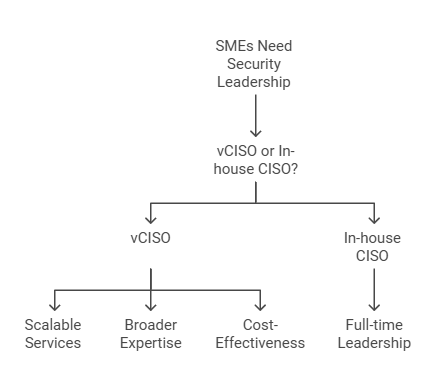
Considering the budget and resource constraints of SMEs (small and medium-sized enterprises), vCISO is a better choice to get higher expertise over a diverse technological background.
Choosing the Right vCISO
Are you finding yourself at a crossroads to figure out which one to choose, vCISO vs CISO? Both of them have their advantages and disadvantages; your choice largely depends on your budget, resources, and cyber security demands. Consult our experts in Wattlecorp to comprehend your cyber security posture; our team will help you in determining the best solution tailored to your organization’s needs.
If you are looking for vCISO combines a wide range of benefits including expert guidance towards building a comprehensive cybersecurity strategy with an assurance to support the organizational objectives, contact Virtual CISO (vCiso) Consulting & Advisory Services In UAE, Dubai for a better service.
vCISO vs CISO FAQs
1. Is a vCISO as effective as an in-house CISO for cybersecurity management?
2. How much does it typically cost to hire a vCISO compared to a CISO?
3. How do vCISOs handle emergency cybersecurity incidents compared to in-house CISOs?

 Qatar Cybersecurity Boardroom Accountability: Why QCB and NCSA Now Expect Executive Ownership
Key Takeaways: Cybersecurity in Qatar is increasingly becoming an executive governance responsibility, with national cybersecurity initiatives and sector-specific requirements encouraging organizations to establish stronger leadership oversight. QCB and NCSA play important roles in strengthening cybersecurity governance in Qatar, with QCB focusing on financial sector requirements and NCSA supporting national-level cybersecurity coordination and guidance. Executives can’t […]
 Data Privacy Consulting for Saudi Enterprises: How to Operationalize PDPL Data Subject Rights in 2026
Key Takeaways: The Saudi data protection law may apply to organizations outside the Kingdom when they process personal data related to individuals in Saudi Arabia, meaning geographic location alone does not automatically exclude an organization from PDPL obligations. PDPL data subject rights span access, correction, deletion, and consent withdrawal, and enterprises are on the hook […]
 Third-Party Vendor Security Risk Assessment Under DPDP: A Guide for Indian Enterprises
Key Takeaways: Third-party vendor risk assessment with DPDP practices helps Indian enterprises to verify that external partners handle personal data with adequate safeguards. The Digital Personal Data Protection Act holds data fiduciaries accountable for vendor conduct, which makes due diligence a legal and operational necessity. A structured vendor security questionnaire, covering encryption, access control, and […]
 Virtual CISO Services for UAE Free Zone Startups: Affordable Security Leadership for Growing Companies
Key Takeaways: Most startups already hold sensitive data such as customer info, source code, financials, long before they feel big enough to take security seriously, and that’s exactly when the risk starts. A virtual CISO gets you someone who’s done this before, setting up strategy and guiding compliance, without the cost of putting a full-time […]
 SOC as a Service for Indian BFSI and FinTech Companies: 24/7 Monitoring for CERT-In Readiness
Key Takeaways: SOC as a Service for BFSI and FinTech India gives banks, NBFCs, insurers and digital lenders continuous security visibility without the cost and hiring effort of building an in-house operations centre. CERT-In directions require regulated entities to report qualifying cyber incidents within six hours of detection, and implementing SOC for BFSI and FinTech […]
 SOC as a Service in India: How It Works, Pricing, and Why Businesses Need It
Key Takeaways: SOC as a Service helps Indian businesses to get 24×7 security monitoring without huge cost and complexity of building a full in-house security operations center. A managed SOC check and analyse beyond basic log monitoring, which combining SIEM, threat intelligence, analyst-led alert triage, incident escalation, reporting, and security response support. SOC as a […]